Wednesday, January 07, 2015

Cowardice: Did it ever go out of style?

It was just over five years ago that we were writing about censorship at Yale. On that occasion Yale University decided to excise the Danish cartoons from a scholarly work examining freedom of expression and the cartoon controversy.

As we said at the time: So what does it say when one of our greatest universities lacks the courage of a small newspaper in Denmark?

Again it's a tiny publication in comparison to one of our great institutions of journalism, and again the terrorists and murderers have won.

Yes, the New York Times has decided that it won't publish the cartoons published by Charlie Hebdo that apparently led to the murders of twelve free people. The same is true of NBC News. And the Washington Post.

Here's one of them:
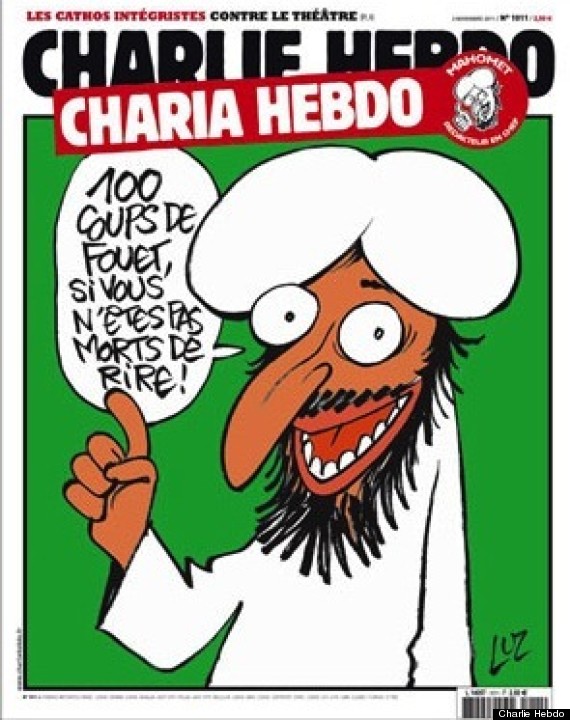

Pretty crude and juvenile, right? Muhammad is depicted as saying, "100 lashes if you don't die of laughter."

The voices of "responsible" journalism have the usual things to say: they're not being intimidated, they're being sensitive; they are never in the business of being offensive just for the sake of being offensive; how can they justify putting their employees at risk?

The thing is, though, that freedom of speech is important to us here in America. We figured out a long time ago that we can't have a democratic, civilized society without it. If some people are offended, so be it.

And the other thing is that there's no limit. There's no way a writer, an editor, or a publication can say, "If I just give in to them on this one point it'll be okay." There's never just one point. Once you let the terrorists decide what you can publish they'll be making that decision for you and your readers every day, and all of a sudden you're out of the journalism business and into--well, I don't know what you call it at that point.

Coincidentally, down in Maryland we just observed the case of an idiot politician threatening to sue a local newspaper any time they published his name. They didn't back down, and they made him a laughing stock. Rightly so. That was an easy one, though, because the entire world knew that he couldn't make it stick: his was a hollow threat.

The threat to kill journalists who publish pictures someone doesn't like has repeatedly been shown not to be a hollow threat at all. Still, the fundamentalists and terrorists don't get to win, because after they win one, what's to stop them from winning all of them?


Labels: , , , , ,

Sunday, October 23, 2011

Inside the mind of the censor

Almost four hundred years ago, John Milton published Areopagitica, a treatise in opposition to censorship of the press. Although he was not entirely in favor of unfettered expression, he argues that a regime of censorship gives power to the narrow-minded type of men who will fear and try to suppress any expression that threatens their world view.

As Vince Blasi, one of my Con Law professors puts it: The lowly wisdom of Areopagitica is considerable. Milton insists, for example, that the policy of licensing cannot be assessed without taking into account the capacities, incentives, working conditions, loyalties, and temperaments of the persons who will serve as licensers. "There cannot be," he says, "a more tedious and unpleasing journey-work, a greater loss of time levied upon [a man's] head, than to be made the perpetual reader of unchosen books and pamphlets, ofttimes huge volumes .. . and in a hand scarce legible, whereof three pages would not down at any time in the fairest print." With such a job description, "we may easily foresee what kind of licensers we are to expect hereafter, either ignorant, imperious, and remiss, or basely pecuniary."

Our Founding Fathers rejected the rule of this type of person by permanently enshrining the freedom of the press as the paramount value of the Bill of Rights. Among other things, and subsequent case law embodies this, freedom of speech and of the press are vital to the polity because of their consequences: they enable a democratic populace to govern themselves.

What the mind of the censor, as described by Milton, fails to understand is that censorship doesn't work.


Take the book I'm reading now, The Black Banners by Ali Soufan. You've probably heard of it because of Soufan's argument and demonstration that torture doesn't work in general, and in particular was counterproductive in investigating the truth behind the September 11 terrorist attacks.

Another topic, though, is the ridiculous examples of censorship to which Soufan has been subjected. Here are a couple of examples:

Again [1 word redacted] was going with my instinct. [1 word redacted] didn’t know that they were friends, but [1 word redacted] guessed that, given Abu Zubaydah’s knowledge of KSM’s role in 9/11, they must be—and again [1 word redacted] wanted to make Abu Zubaydah think that [1 word redacted] knew all about their relationship.

And: As [1 word redacted] was drawing up an interrogation plan, at around 3:00 AM, the CIA medic tending to Abu Zubaydah came to my room. “Hey, Ali, how important is this guy?” he casually asked. He knew nothing about Abu Zubaydah and was only at the location because of his medical skills. “He’s pretty important,” [1 word redacted] replied.

There are other examples. I'm reading the book on Kindle, so the censorship is turning up as a notation of the number of words redacted. In the print version it is different: black marks covering up the words, as had previously been done with Victor Marchetti's The CIA and the Cult of Intelligence, so commentators have observed that the redactions are ineffective because the reader can tell, for example, that the word redacted consists of a single letter.

In the quoted portions above, it is obvious that the redacted word is "I". For instance, what other word would make sense in "[1 word redacted] was going with my instinct"?

There are longer redacted passages, where the content isn't obvious, but it seems likely to me that in context, to someone who has read other sources, like the various investigation and government reports on the attacks, there wouldn't be much that you couldn't figure out.

Coming out of the Bush Administration's criminal activities, including torture and unprovoked war of aggression, free debate is essential. The redactions in The Black Banners demonstrate that the mind of the censor is directly and always opposed to such free debate.

Labels: , , , , ,